Hearing Yourself Again
A coffee shop, a stranger, and the quiet work of learning to be alone.

Not every day on the road was motorcycles and survival. Some were just... days. Coffee shops, strangers, the quiet work of learning to be alone. This excerpt is from a week I spent in Jasper, waiting for a package that wouldn’t arrive—and a conversation that stayed with me longer than I expected.
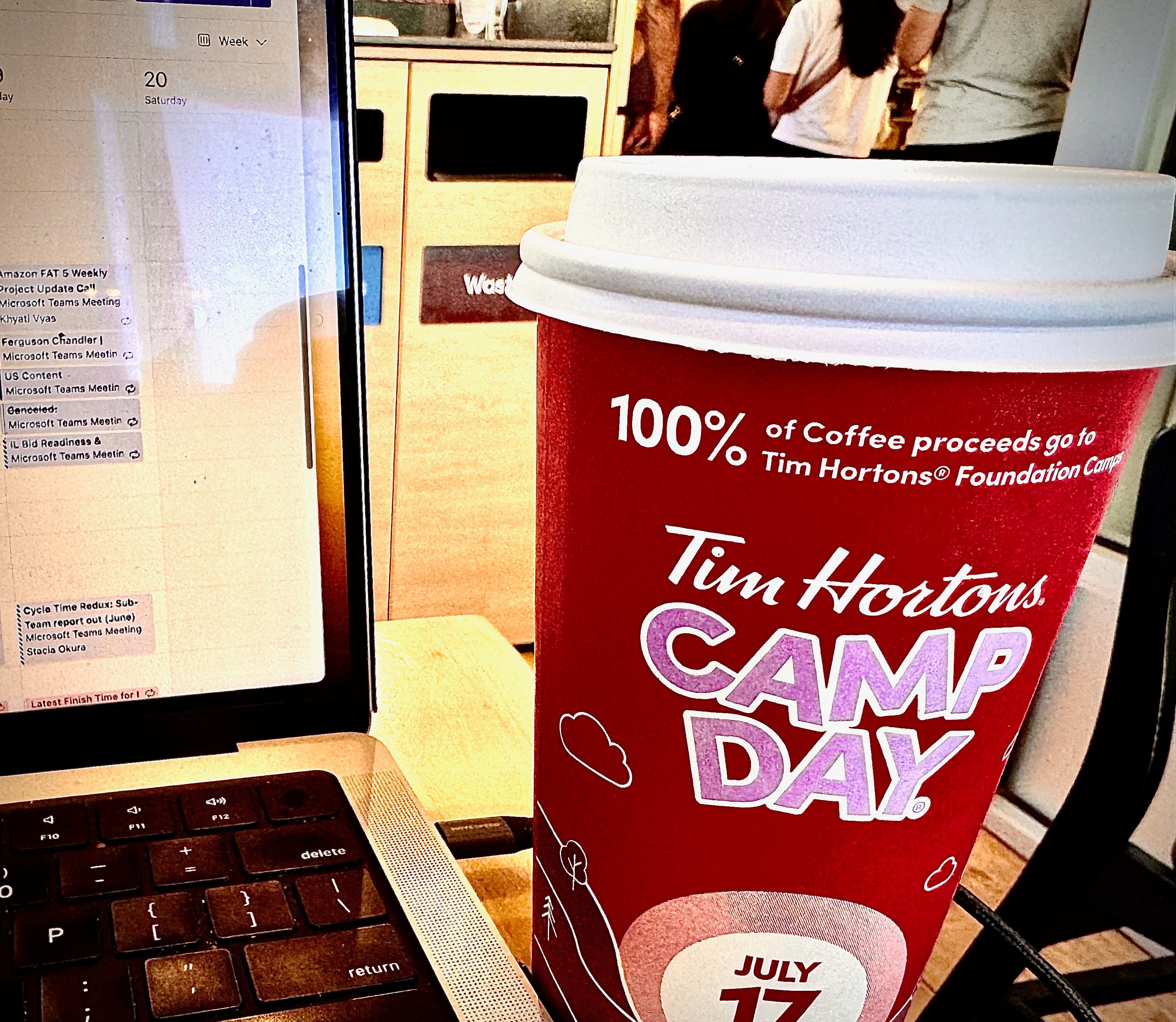
The week found its pattern. Mornings I worked in coffee shops. Tim Hortons, then Starbucks, tethered to Wi-Fi and obligations. Evenings I chased sunsets, followed roads I’d never seen, stopped when the pie looked good.
Monday, July 15
Morning at Tim Hortons. I’d claimed a table near an outlet, laptop open, coffee cooling, when an older man appeared at my shoulder, muttering something sharp under his breath — something ending in “ … sucker.”
In his sixties, worn hard. Hands scarred, face lined deep. He had the look of someone displaced and wandering. I’d seen him pacing near the entrance earlier, his lingering stares hard to ignore. Now he was seated just feet from me, eyes locked.
“Sorry, problem?” I asked.
“Yeah, you know!” he snapped.
Part of me wanted to stand my ground. I’d claimed the table fairly. But being an American in spaces that carried their own history made me recalculate. I was in his home.
“Would you like me to move?”
Politeness seemed to enrage him further. Accusations about tourists followed, anger spilling from some deeper well. My mother’s words surfaced: When you travel abroad, you’re an ambassador for your country.
“Take the table,” I said, packing up. “Can I buy you lunch?”
The offer hung there. The barista at the register looking on, him half-seated, me holding my bag. Then his expression shifted — surprise, suspicion, a small crack in the anger. He took the seat but declined the meal with a “Nah.”
As I packed up my laptop, I heard him mutter to the barista: “Fuckin’ American.” But there was almost a smile in it. Whatever he’d expected, it wasn’t kindness.
My mother would have been proud. Or confused. Possibly both.
I found a nearby table and worked the rest of the morning with a persistent side-eye on my new friend.
By noon I needed a break. Montana’s BBQ and Bar sat a few blocks from the main drag — wood-paneled, smoky in the right way, the kind of place where the menu doesn’t apologize for anything. I ordered brisket and a beer and watched tourists navigate the sidewalk through the window. Nobody here seemed to be in a hurry. I was learning not to be.
That afternoon I switched to Starbucks, and that’s where I met Cheryl.
She was already set up in the corner — laptop, iPad propped beside it with a route map glowing on screen, travel mug, noise-canceling headphones around her neck. Mid-thirties, the kind of tan you get from living outdoors rather than seeking it. Through the window, a Subaru Outback packed to the headrests.
She glanced up when I arrived. “Creature of habit?”
“Or just good Wi-Fi.”
We worked in parallel for most of the afternoon, the way strangers in coffee shops sometimes do — aware of each other without needing to talk. She took calls throughout the day, her voice shifting into something practiced and patient. Training, maybe, or customer support — the kind of work that requires presence without proximity. Between calls she’d swipe through her route map, adjusting pins, calculating distances.
Eventually, she asked what brought me to Jasper.
“Heading to Alaska. That’s my bike out there.”
“I’m camping just north of here,” she said. “Been traveling through Canada and the US for two years. Quebec originally.”
I didn’t ask where she was staying. A woman traveling alone might not want to trust a stranger with that.
We talked in fragments between work — her route through the Maritimes, a transmission problem in Manitoba that stranded her for a week, the mechanic who fixed it and refused full payment. She’d worked remotely from campgrounds, libraries, motel lobbies. Two years of it, and she seemed more settled than most people I knew with permanent addresses.
I expected two years of solo travel to show as loneliness. It didn’t. Whatever she’d found out here, it hadn’t cost her the way I assumed it would.
Tuesday, July 16
Cheryl already had her laptop open when I arrived.
“Need a charge?” she asked, sliding over her battery pack.
We fell into the same rhythm — working, talking, not talking. She took another string of calls, patient with each one, then pulled off her headphones and rubbed her eyes.
During an afternoon lull, I asked what the hardest part was.
She didn’t hesitate. “The people who wait for you.” She turned her mug in her hands. “My mom calls every Sunday. My sister sends pictures of her kids growing up. They don’t complain — that’s what makes it harder. They just quietly make room for my absence and hope I’ll come back soon.”
“And you feel that.”
“Every week. The freedom out here is real. But so is the gap it creates back home. You have to tend to it. You can’t just assume they’ll understand.” She looked at me. “You have kids?”
“Two. Both adults.”
“Then you know. They’ll tell you it’s fine. They might even mean it. But the distance still costs something, and if you’re not careful, you’ll realize too late what it cost them.”
My coffee had gone cold without my noticing.
That evening, I rode south toward Sunwapta Falls — thirty-four miles back down the Icefields Parkway, the same road I’d taken into Jasper but different now, unhurried, with nowhere to be. The road swept through spruce forest, long views opening across glacier-carved valleys. Traffic had thinned with the hour. The mountains appeared suddenly around bends, closer than they had any right to be.
At Sunwapta, the river gave no warning. One moment a wide glacial flow, turquoise with rock flour, the next it narrowed to a gap in the rock and dropped violently into the canyon below. I stood on the viewing bridge and felt the sound in my chest. A short trail led to the lower falls through dense forest and moss-covered ground. Down there the canyon opened slightly and the water felt more powerful, more remote.
I rode back in the long light, Cheryl’s words somewhere behind me on the road.
Wednesday, July 17
I arrived early. Her corner table was empty.
Mid-morning she appeared, travel mug in hand, already packed.
“Heading out,” she said. “System’s moving through. Better weather toward Calgary.”
“Safe travels.”
“You too.” She hesitated. “Don’t wait too long.”
Then she was gone. No numbers exchanged. No promises to stay in touch. Just someone who’d shared a few quiet afternoons and then moved on, the way travelers do.
Her table stayed empty the rest of the morning. I worked through lunch without noticing.
This is an excerpt from my forthcoming memoir about riding a motorcycle from Austin to the Arctic Ocean.